

There are a number of standards and accreditations, such as the National Association of Security Dog Users (NASDU) to regulate the usage of dogs in security environments.
In this guide, we explore sniffer dog training and the activities that security dogs undertake before they’re ready for operational duties, from building a strong bond with their handler to mastering obedience, agility, protection, and scent detection skills. We’ll also look at the specialist techniques used to train drug detection dogs, the different patrol methods they may use in the field, and how these highly skilled canines become an integral part of a professional security strategy.
Key Takeaways
- Scent Association Method – Sniffer dogs are trained to associate the smell of specific substances with a reward, such as a toy or treat, making detection work exciting and motivating.
- Positive Reinforcement Focus – Training uses play-based rewards to encourage accuracy, consistency, and enthusiasm, ensuring dogs stay engaged and effective in the field.
- Indication Techniques – Dogs are taught clear signals to alert their handler, either passively (sitting or standing) or actively (digging, pawing, barking) when a target scent is found.
- Training security dogs
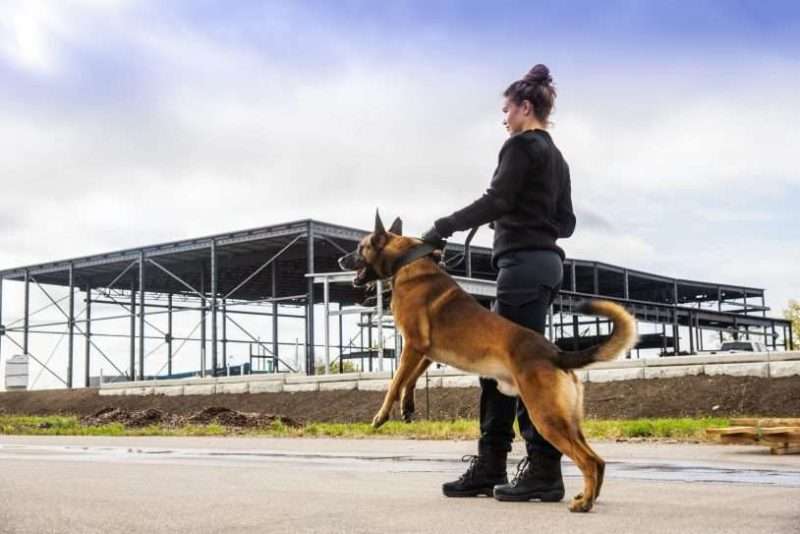
Training a security dog starts with their handler, who must undertake rigorous studies and practical testing to hold appropriate registrations and accreditations.
Usually, a canine security team will consist of the same handler/dog combination, who are experienced in working together and communicating with each other.
There are multiple stages to training security dogs, including:
- Obedience training, so that the dog can respond immediately to any number of commands including which direction to turn, sitting, staying, leaving and recall.
- Agility training – security dogs are agile and fast. Their training includes learning how to navigate serious obstacles such as solid walls, long jumps and high fencing.
- Protection training – security dogs are usually taught to bark when they sense an intruder. They are also trained in protecting the welfare of their handler, and how to apprehend intruders safely.
Sniffer dog training for drug detection
One of the most popular reasons to consider using K9 security is in locations where there is potential for drug abuse.
Security dogs aren’t there to be petted. They are highly trained, efficient and focused. Drug detection dogs surpass the accuracy of any human interaction or manual screening.
Professional dog handlers train these canines using toys and treats – so they find their work exciting, challenging, and fun.
In essence, a drug detection dog is taught to associate the smell of the substance(s) they are screening for with a toy, or perhaps a preferred treat. This creates a tangible link between sourcing any drugs, and the smell of the dog’s favourite toy.
The benefits include:
- Having a flexible security approach, with dogs working either on or off the lead.
- Fast reactiveness when drugs are detected.
- A passive security presence to avoid the intrusion of manual screening.
- Reliability and accuracy of drug detection.
- Assistance and support for human security personnel.
- The ability to screen large areas or numbers of people simultaneously.
Locations where drug prevention is critical include:
- Open plan event spaces.
- Multi-occupancy premises.
- Public events.
- Educational establishments.
- Borders and boundaries.
Identifying drugs with canine patrols
Detection dogs are trained to let their handler know when drugs are present. This indication can be given in several ways, depending on the type of training.
- Passive indications occur when the dog is trained to sit or stand when they detect drugs.
- Aggressive indications include digging, pawing or barking at the location.
Similarly, security dogs work in a variety of ways, and the most appropriate solutions depend on their purpose and the site they are protecting.
Passive patrols use a dog on a lead that is under the control of their handler at all times. This type of patrol is unintrusive and helps security guards to identify potential issues or detect drugs, without any direct contact.
Proactive patrols usually have the canine off the lead, although they remain under firm control. This allows for more detailed searches and is ideal in busy areas or where large premises require searching.
Dual-purpose patrols cover both types of security and can respond accordingly to situations or risks that arise.
Choosing the right security dog unit
One of the many benefits of using canine security is the flexibility of services available. Some dog patrol units specialise in particular types of protection, whereas others will cover a wider remit.
Dogs are popularly used in patrol services, where their superior speed, hearing, agility and sense of smell can identify intruders far quicker than any trained security guard.
This type of patrol is often a deterrent in itself, as the majority of criminals will avoid any sites or businesses with a canine patrol, choosing to target more vulnerable settings with weaker security.
Every Clearway canine security team holds NASDU accreditation, upholding the highest standards of professionalism and skill. This qualification involves regular professional training, so you are assured that your security team remains at the forefront of new protection techniques.
For more information about how dog security patrols and drug detection services can augment your site safety, contact the Clearway team who can recommend the most robust solutions for your requirements.